Friday, September 23, 2011

Genocide, a lesson we will never learn


He who does not learn from History
(Rwanda)
is doomed to repeat it!
in Yemen


A winner is a dreamer who never gives up -Nelson Mandela

A Nation without a Voice


With the continuous war crimes from Saleh's regime against the millions of innocent people and the sickening silence of the international community( which by the way have proved to the world that they very much  enjoy seeing blood.) has made me realize that we cannot afford to simply just talk about supporting Yemen, we must actively work hard for it. 
Yemen is not Egypt, Syria or Libya. The world just does not care for Yemen

I wonder if  the International community (mainly the  government of the United States and Saudi Arabia)  have any shame left. The Yemeni community have the right to keep and  bear arms, they could be turning Yemen upside down by fighting this horrifying regime with their  ak-47s but instead they use their chests as their shield and videos as their weapon.  Now  A NATION IS BEING SLAUGHTERED  and the International community's hypocrisy and selective silence is to heap the responsibility. 


 I am espessially disgusting  by  Yemen's neighbor whose government has been providing  Saleh with weapons  to destroy his own people. I am also disgusted by the rest of the Arab leaders because their silence signals their acceptance.  The United States is also part of the problem. They continue to focus only on the  security issue in Yemen, specifically their "growing concern for  AQAP presence"  but clearly it's bullshit. If they were really concerned they would not be turning a blind eye on the country's escalating humanitarian and human rights situation. Any efforts by the U.S.  to fight Al Qaeda  will probably now be ineffective.


Why should the Yemeni people assist  with the United States in counterterrorism efforts if the U.S. are not helping or respecting  the Yemeni people? Glosses over their peaceful resistance and human right abuses will only backfire on the United States. The current atrocities and crimes against humanity are clear  violations of  the ethics and principle of justice, freedom and human rights.  


After 8 months of brutal violence and mass murder  who would blame the peaceful protestors if they end up resorting to extremism ? I sure as hell won't. This must be what the  U.S. wants. If they were seriously concerned about the growing presence of AQAP  it wouldn't be ignoring the Yemeni populaitons demands for BASIC human rights.    


In short, Yemen, is not about  “security” or “terrorism”. It is  about a country drowning in blood.                                                                                                                                                                   CLEAR GENOCIDE & MASS MURDER  is being supported by the Arab leaders, the United States, Russia, probably even the United Nations.  What exactly for? Power? money? media? 
.  

Below is a video that is may be to difficult for some to stomach but if you can please watch. 


Breaking the Silence; #SupportYemen

Wednesday, September 21, 2011

The Enemies of Yemen


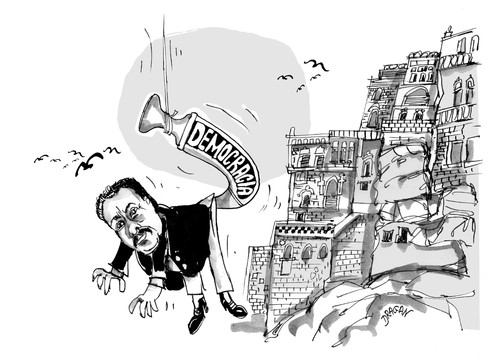
Funny photos and cartoons that have been circulating online


A Voice from Yemen


By ABC Sydney, Ben Millington

Yemen was once the home of the Queen of Sheba, the land of milk and honey, the place where the wise men collected frankincense and myrrh, and most simply, the place that makes God smile.
Sadly this image has taken a bit of a battering in recent times. Terrorism, Al Qaeda, kidnappings and tribal wars are what grab the headlines these days.

In 2009 I was lucky enough to visit Sana'a, the beautiful, world heritage listed capital of Yemen. Aside from the stunning architecture, I found warm friendly people and a hospitable culture unlike any other in the Gulf. I was welcomed into homes, attended a wedding party and was greeted by smiling faces in every street, shop and market.

The man who helped open this window was Kais Al Kalisi (pictured), a local tourism operator who I spent several nights with chewing qat leaves and talking about life and politics. At the time Kais talked about his dream for a democratic government and an end to corruption, now he is acting.

Inspired by recent revolutions in Egypt and Libya, Yemenis are protesting around the country in anti-government demonstrations. The last few days have seen bloody clashes and dozens killed as government forces reportedly opened fire on protesters.

Kais has been among the protesters and I spoke to him last night.

"It was a real blood bath," he says.

"We did not expect the government to be too tough to us, we were a peaceful demonstration showing we want the government to step down.

"We were faced suddenly by the republican army which was shooting us, like hunting birds. It was a massacre."

It was a sobering conversation, which ended with Kais saying he was inspired by the fact that countries like Australia were reporting on the situation. I was humbled, and hung up thinking about a unique country on the other side of the world, but with very complex problems and very real people living with them.

Listen to the full interview:

Monday, September 19, 2011

Sanaa Massacre

In Yemen, Peaceful protestors are met with brutal violence by Security Forces loyal to Ali Saleh

NPR, Michele Norris speaks with Erika Solomon, Gulf correspondent for Reuters, about clashes between government troops and protesters in Yemen Monday.


MICHELE NORRIS, host: From NPR News, this is ALL THINGS CONSIDERED. I'm Michele Norris. And we begin this hour in Yemen, where at least two dozen anti-government protesters are dead and more than 200 are wounded. That's after they attempted to leave the confines of their encampment in the capital, Sanaa, and march peacefully through the city streets. Yesterday was the first time in months protesters have tried such a march, and security forces as well as gunmen dressed in civilian clothes opened fire, some from rooftops.

The result, one of the bloodiest days in Yemen since March. Erika Solomon is in Sanaa reporting for Reuters, and she joins me now. Erika, tell us more about what exactly set off the violence yesterday and what's been going on today.

ERIKA SOLOMON: Well, protesters had for weeks been discussing a need to escalate the situation. They've been languishing in their protest camps for months, having small protests but not really pushing in any way to either get the government's attention or, say, media attention, and they felt that they needed to recapture the momentum that they had lost. So they started a march outside of the usual confines of where they are known to protest. The city of Sanaa is divided right now. Part of it is under control by the defected troops of General Ali Mohsen who threw his weight behind protesters several months ago, and the rest of the city is still controlled by government forces.

So they went into an area that was considered the dividing line between these two sides. They knew that this might cause violence, but they thought it was worth the risk in order to try and push through what has been months of a very, very frustrating political stalemate for them.

NORRIS: And, Erika, what's been happening there today?

SOLOMON: The protesters did manage to take some of this area on the dividing line, which I described to you, and they camped out there overnight. Very early in the morning, there was large explosions and gunfire. What he heard from witnesses, as well as from a Reuters cameraman nearby, was that they saw people shooting from the rooftops, and they believe they were government forces. The protesters started fleeing. And as the day went on, it went from something of protesters being attacked to clashes between the defected troops and the government forces.

And it became a kind of military confrontation, which was something, I think, that all sides in Sanaa and in Yemen were concerned about happening. This is something that they wanted to avoid, and I'm pretty sure they're going to be keen to try and step away from as soon as they can.

NORRIS: Who were these protesters? Are they mainly young people?

SOLOMON: I was in the field hospital today. I saw a 10-month-old child, and I saw, you know, 70-year-old men in this area where the protesters are. And you have families, high school students. They're very much driven by a spirit created by the university students who started this protest earlier on in January and February.

NORRIS: What was the scene like at the field hospital that you visited?

SOLOMON: It was very traumatic. And they don't have a lot of space. They're working out of a mosque. And, obviously, that's not the same as having a hospital. So their doctors seemed pretty well organized. They had a system for bringing in the wounded, but they were just coming in so quickly you just have streams of five and 10 and 15 wounded people being rushed in on stretchers or on motorbikes and just being laid out on the floor as they quickly try to pull out bullets and so on. And then in one corner of the room, they were laying out the dead, and obviously, the scene there was - is quite difficult. Families were huddled around praying and crying.

NORRIS: Now, as this was taking place, the president, Ali Abdullah Saleh, had met with King Abdullah in Saudi Arabia. Is it expected that he will address his countrymen at some point as this is going on?

SOLOMON: What I'm hearing actually right before I got on the phone with you is that they might have agreed a kind of cease-fire. It's not quite clear to me yet that that deal has been finalized. I think it really depends on how tonight goes in terms of diplomatic negotiations.

NORRIS: Erika Solomon is a reporter for Reuters. She was speaking to us from Sanaa in Yemen. Erika, thank you very much.

SOLOMON: Thank you.

Wednesday, September 14, 2011

Water, Peace and the Arab Spring

What are your thoughts?

In 1994, Yale World Fellow Gidon Bromberg co-founded EcoPeace, a unique regional organization that brings together Jordanian, Palestinian, and Israeli environmentalists to promote sustainable development and advance peace efforts in the troubled Middle East, and in 1997 led the entry of the organization into Friends of the Earth International. He has spearheaded the advocacy campaigns of the organization both in Israel and internationally and developed the cross border community peace building program "Good Water Neighbors" that is seen as a model for other programs in conflict areas. Bromberg speaks regularly on water, peace, and security issues, including at the UN Commission for Sustainable Development, the US House of Representatives, the European Parliament, and the UN High Level Panel on Security. He is a member of the EastWest Institute's International Task Force for Preventive Diplomacy. Bromberg was named an 'Environmental Hero' by TIME Magazine, and was, with his co-directors, awarded the prestigious Skoll Award for Social Entrepreneurship.